Most commercial murals occupy predictable real estate. The lobby. The feature wall facing street traffic. The exterior facade visible from the parking lot. These are all good, safe choices.
But the work that tends to stick—the murals people remember weeks later, the ones that actually change how a space functions—often lives elsewhere. Parking garage murals that solve wayfinding problems. Warehouse mural painting projects with floors marked by zones instead of numbers. Dental office ceiling murals that give anxious patients something besides acoustic tile to contemplate.
Location matters as much as scale or subject. A mural fighting for attention on a congested street corner competes with every other visual stimulus in a 180-degree field. The same mural on a parking structure art wall, or a break room ceiling, or a conference room that seats twelve—it operates in a different economy of attention. Less competition. More time. Captive audiences who aren't moving at 35 miles per hour.
Interior Walls: The Controlled Environment
Interior wall murals occupy a different psychological space than their exterior counterparts. Outside, you're competing with traffic patterns, weather conditions, competing signage.
Reception areas get most of the attention, and reasonably so—they're the “handshake moment.” But the more interesting applications tend to happen in spaces where people have time and nothing else to look at.
For Rivian, the electric vehicle manufacturer, we created an interior wall mural featuring an abstract landscape with geometric forms—warm oranges, teals, and greens that brought energy to their office space. The mural sits behind a reading area with shelving and seating, transforming what could have been generic office real estate into a space employees want to occupy. Murals for office spaces don't just decorate—they signal that the company values thoughtful environments.

Commercial interior murals don't weather. Proper surface prep and quality paint can hold for two decades without touch-ups. No UV fade, no water damage, no graffiti to buffer. The work stays pristine as long as the building does.
Floors: The Overlooked Plane
Floor murals disrupt expectations, which is precisely why painting them works.
For Brooks Running, a performance footwear and apparel company, we painted leaf patterns directly onto flooring in their retail space. The floor itself became part of the brand experience. Social media posts of the installation extended the reach well beyond the physical store.
.jpg)
The applications vary, but the logic is remains the same: floors are seen constantly and remembered rarely. Make them memorable.
The constraint is durability. You can't really approach a floor mural the way you approach a wall. Industrial-grade coatings, slip-resistant additives in the top layers, careful attention to moisture levels—the technical requirements are stricter. But done properly, a floor mural handles forklift traffic. We've tested it.
Ceilings: The Forgotten Surface
Ceiling murals are what architects call the fifth wall. Most people call them nothing at all—they're just there, white and utilitarian, occasionally interrupted by HVAC vents or fluorescent panels.
The challenge isn't painting ceilings. It's giving people a reason to look up. Ceiling murals work best in spaces where pause is built into the program: waiting rooms in medical offices, dining areas in restaurants, and lobbies with seating arrangements designed around dwell time. Places where looking up isn't an interruption but a relief from looking at phones.
The technical consideration: ceiling work is overhead work. Paint drips become gravity problems. Physical endurance matters—try holding your arms above your head for eight hours and maintaining fine motor control. The work usually takes longer and costs more per square foot than wall murals.
But almost nobody paints ceilings. Which means the impact-to-competition ratio is favorable.
Small Interventions
Not every mural needs to announce itself at scale. Some of the most effective office wall art murals applications are small but strategic.
Doors create transitions. A painted door signals threshold, suggests that something different exists on the other side. Small moments accumulate when thoughtfully executed.
Stairwells are transition zones where people default to phones. A mural in a stairwell gets attention not because it demands it, but because there's nothing else competing for it.
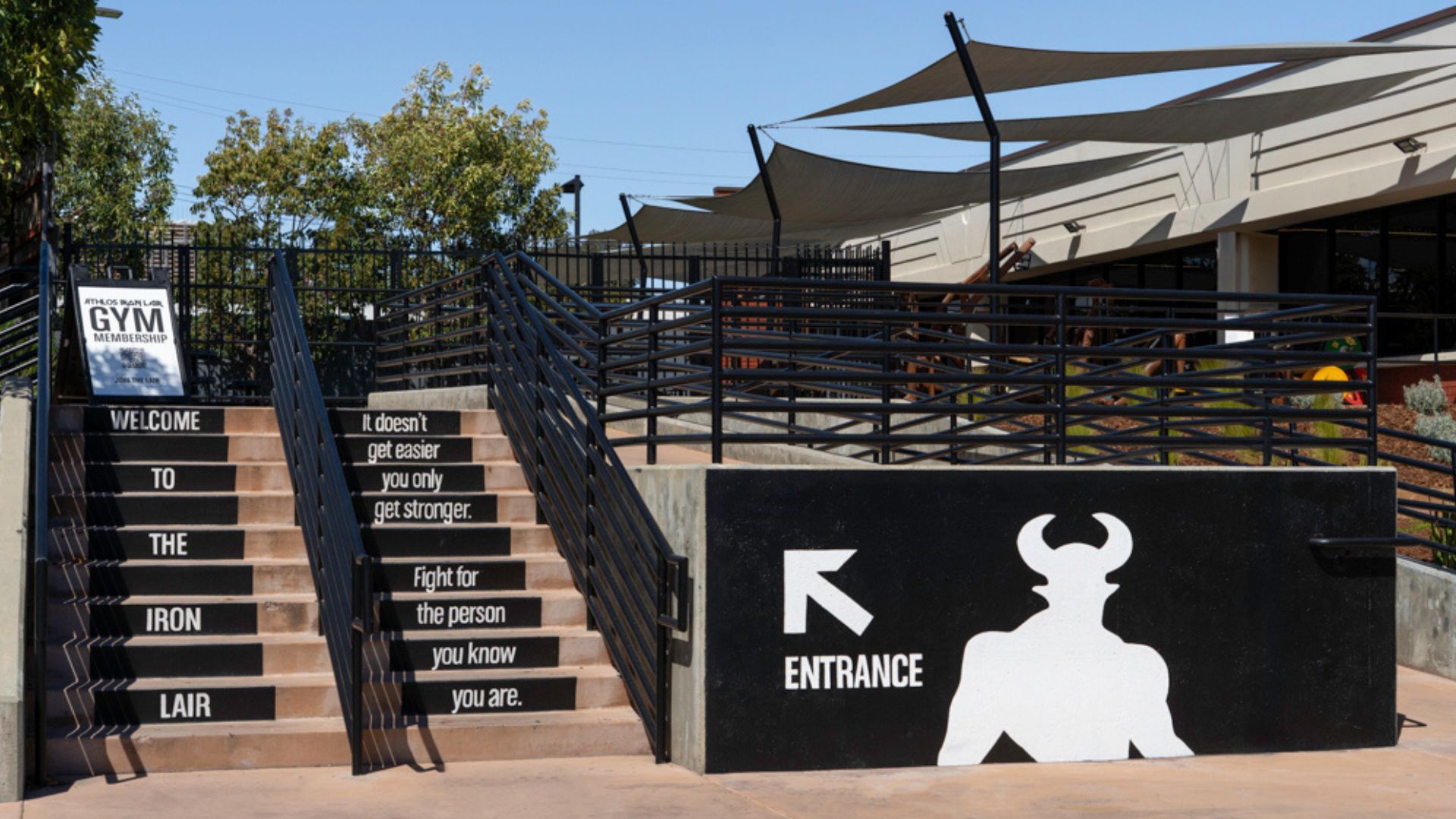
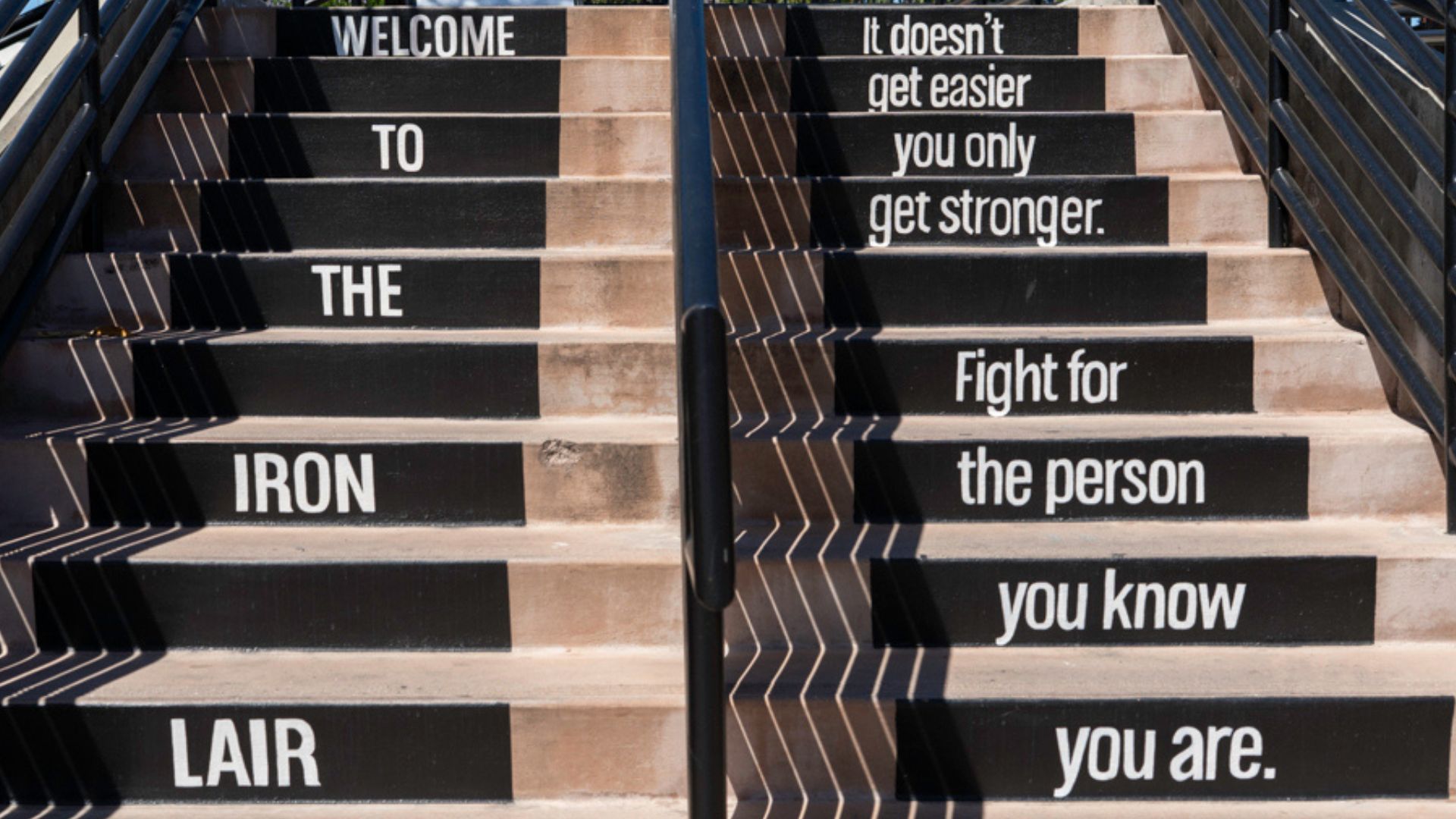
At Iron Lair, a Los Angeles gym, we painted motivational text on outdoor stairwell risers. Members climbing those stairs read the message with every step— building the mindset while building their strength. The stairs became part of the workout philosophy, not just the path to it.
The advantage of small-scale work: lower risk. Painting a door or column could range from $500 to $2,000. If the result isn't what you wanted, the stakes are manageable. Usually, though, one successful small intervention leads to requests for more.
Technical Considerations
Not every surface accepts paint equally.
Surface condition: Concrete floors require different preparation than drywall ceilings. Porous substrates need sealers. Glossy surfaces need mechanical abrasion or chemical etching before primers will bond. Existing coatings must be tested for compatibility. The prep work often takes longer than the painting.
Traffic and use patterns: Floor murals in retail environments need industrial-grade coatings with slip-resistant additives. Ceiling murals in private offices can use standard acrylics. High-touch surfaces require harder, more chemical-resistant finishes. The specification matters.
Maintenance access: Painting over access panels, sprinkler systems, or utility connections creates future problems. We design around these constraints, not over them.
The most successful projects happen when the question shifts from "should we do a mural" to "what problem could a mural solve." When the mural serves a function beyond decoration, the investment justifies itself.
Starting Points
If you're considering work on an unexpected surface, begin with clarity about objectives. Aesthetic improvement? Functional wayfinding? Business branding through murals? Employee retention? The answer shapes everything that follows.
Walk your space with fresh attention. What surfaces do people actually see? What areas feel neglected or underutilized? What physical problems might visual solutions address? Sometimes the answer is obvious—a blank parking garage wall that thousands of people pass daily. Sometimes it's less apparent—a ceiling mural in a waiting room that nobody thinks about until someone points it out.
The technical challenges always vary, but the principle doesn't: every surface is a potential canvas if you know how to prepare it and what it needs to withstand.
The question isn't whether your space has potential. It's whether you're looking at it correctly.
Ready to explore what's possible? Reach out to us to talk about your space.
----------------
About Pulling Paint
Pulling Paint specializes in custom wall murals for businesses and hand-painted signage for commercial spaces. We work with businesses across Southern California to transform overlooked surfaces into strategic brand assets.


